
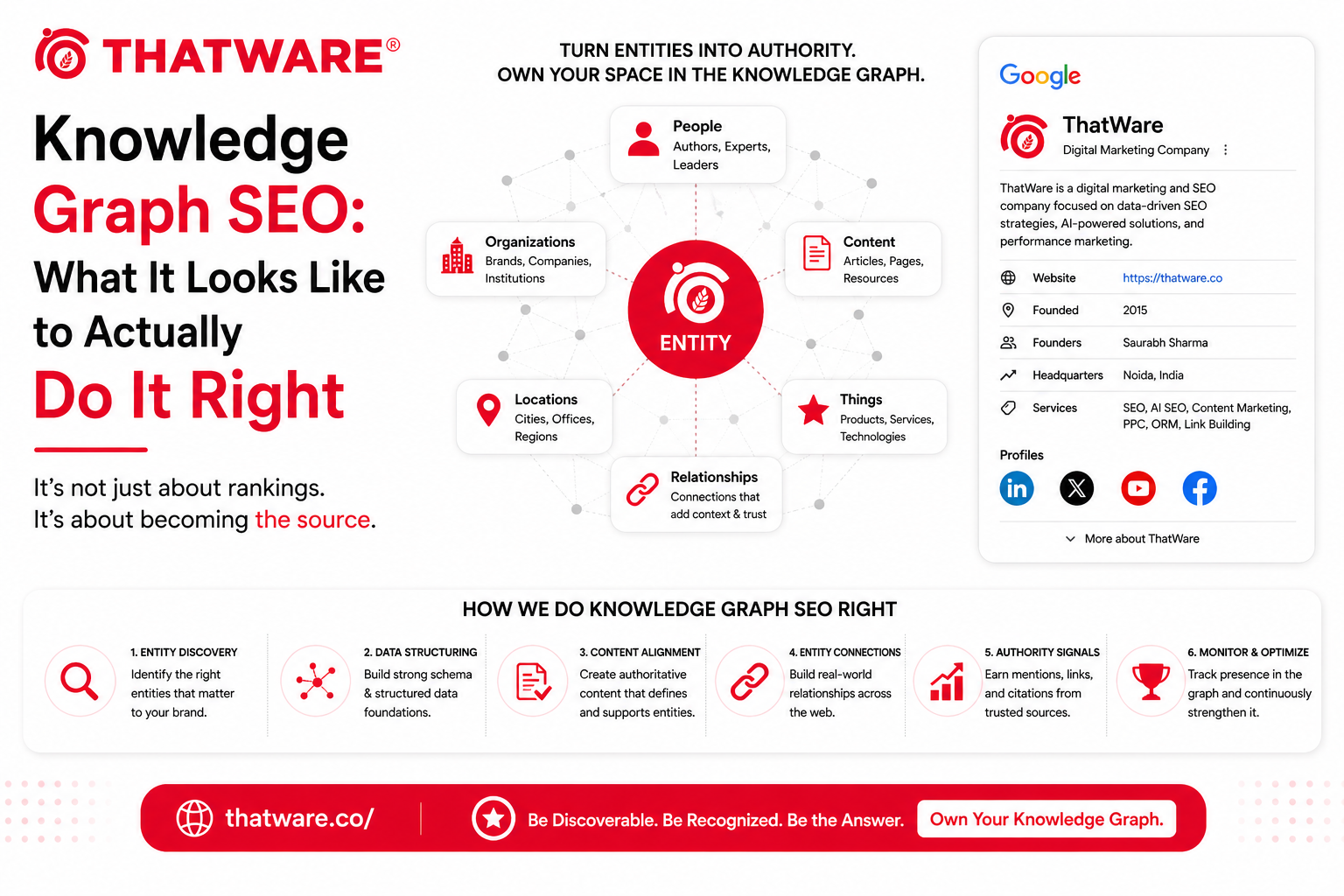
Knowledge Graph SEO is one of those topics that gets discussed at a high level – “you need to build entity authority,” “your brand should be in Google’s Knowledge Graph,” “structure your data so search engines understand your entity” – without much specificity about what “doing it right” actually requires. Most brands hear the concept, nod along, maybe add some schema markup, and then move on without fundamentally changing how they manage their brand’s information footprint across the web.
That gap between understanding the concept and implementing it correctly is significant, and it’s where the real competitive advantage lives for brands willing to go further than the headline.
Here’s what a serious knowledge graph SEO program actually involves, step by step.
What the Knowledge Graph Is and Why It Matters
Google’s Knowledge Graph is a database of entities – real-world things – and their relationships. People, companies, products, places, concepts, events. Each entity has attributes (what it is, who’s associated with it, what it does) and relationships to other entities (this company makes those products, this person founded that company, this product belongs to that category).
When Google evaluates search queries, the Knowledge Graph provides context that keyword matching can’t. Instead of just looking for pages that contain relevant words, Google is looking for entities that are relevant – and evaluating the authority, trustworthiness, and relevance of those entities based on what the Knowledge Graph knows about them.
For brands, this means that how Google “understands” your brand – what it thinks your brand is, what it knows about your expertise areas, who it associates you with, how it categorizes you – directly affects your search visibility in ways that are separate from traditional ranking signals. A brand with a rich, accurate, well-connected Knowledge Graph entity gets evaluated differently from one that Google can’t clearly categorize or whose information is inconsistent across sources.
The Entity Audit: Where Knowledge Graph SEO Starts
Before you can improve your Knowledge Graph presence, you need to understand what it currently looks like. That requires a systematic entity audit – mapping out how your brand is currently represented across the sources that inform the Knowledge Graph.
Search for your brand name in Google and review the Knowledge Panel if one exists. Is the information accurate and complete? Is the right business category shown? Are associated people, products, and social profiles correctly linked? Are there factual errors – wrong founding date, incorrect headquarters location, missing or incorrect description?
Search for your brand name in Wikipedia. Does a Wikipedia article exist? If so, is it accurate and sufficiently comprehensive? If not, does your brand meet Wikipedia’s notability criteria? (Many mid-market and larger brands do but haven’t been written up.)
Check Wikidata – the structured data companion to Wikipedia. Is your brand entity present? Are its attributes correctly recorded? Wikidata is a direct input to Google’s Knowledge Graph, and the more completely and accurately your entity is represented there, the better.
Review how your brand is described across major third-party directories – Crunchbase, Bloomberg, LinkedIn company page, BBB, industry-specific databases. Inconsistencies in how your company is described, your industry categorization, your founding date, or your key personnel create conflicting signals that the Knowledge Graph has to resolve somehow.
Structured Data: The Technical Foundation
Knowledge graph seo services always include rigorous structured data implementation as a foundation. This is the clearest direct signal your own website sends to Google about your entity.
Organization schema at a minimum, implemented on your homepage: your legal name, founding date, founding location, industry, social profiles, contact information, and key personnel. This tells Google’s systems what your entity is and provides anchor points for connecting it to other entities in the Knowledge Graph.
Person schema for key team members: founders, executives, and subject matter experts whose authority contributes to your brand’s E-E-A-T signals should have Person entities with their credentials, employment, and published works correctly attributed. This connects individual authority signals to the brand entity.
Product and service schema for your core offerings: cleanly attributed to the Organization entity, with accurate descriptions and categorization. SameAs markup connecting your products to any existing Knowledge Graph entries for those product categories.
The sameAs property specifically is worth emphasizing. It tells Google which external entities (Wikipedia pages, Wikidata entries, official profiles) correspond to the entity on your page. This connection is how your website’s entity claims get validated against independent sources – and it’s how your structured data contributes to Knowledge Graph enrichment rather than just providing locally-referenced information.
Off-Site Entity Presence: The Harder Work
Structured data on your own site is necessary but not sufficient. The Knowledge Graph is built primarily from third-party sources – what other credible sources say about your brand, not just what you say about yourself.
Semantic seo services that address the off-site entity layer systematically work on:
Wikipedia presence: for brands that meet notability criteria, a well-maintained, neutral Wikipedia article is probably the single highest-value Knowledge Graph investment available. It directly feeds the Knowledge Graph, provides a canonical reference point, and significantly improves Knowledge Panel completeness and accuracy.
Wikidata entries: creating and maintaining accurate, complete Wikidata entries for your brand and key associated entities (founders, products, office locations) provides structured entity data that directly informs the Knowledge Graph without the editorial overhead of Wikipedia.
Consistent third-party profiles: ensuring that Crunchbase, LinkedIn, Bloomberg, industry-specific databases, and other authoritative third-party references describe your brand consistently and completely. The Knowledge Graph resolves entity attributes through cross-referencing – consistency across multiple credible sources produces confident entity recognition.
Press and editorial coverage: media mentions that include accurate factual information about your brand (founding date, products, key personnel, industry) contribute to Knowledge Graph enrichment every time they’re indexed. Brands with consistent, accurate media coverage have richer Knowledge Graph entities than those without.
Measuring Knowledge Graph Progress
Knowledge Graph improvements don’t show up immediately in rankings or traffic. They show up first in Knowledge Panel completeness, then in how accurately and completely Google represents your brand in search features, then gradually in the authority signals that affect organic ranking.
Monitoring your Knowledge Panel – both existence and completeness – provides the most direct feedback on Knowledge Graph status. Checking Wikidata for your entity’s attribute completeness is another direct signal. Tracking whether Google’s understanding of your brand’s expertise areas (visible in what queries trigger your brand’s appearance) evolves toward accuracy is a more indirect but meaningful signal.
These are slow-moving metrics by search standards. Knowledge Graph development is a 12-24 month horizon investment, not a 30-day one. The brands that commit to it consistently are building structural advantages that are genuinely difficult for competitors to replicate quickly – which is precisely what makes the investment worth the timeline.